
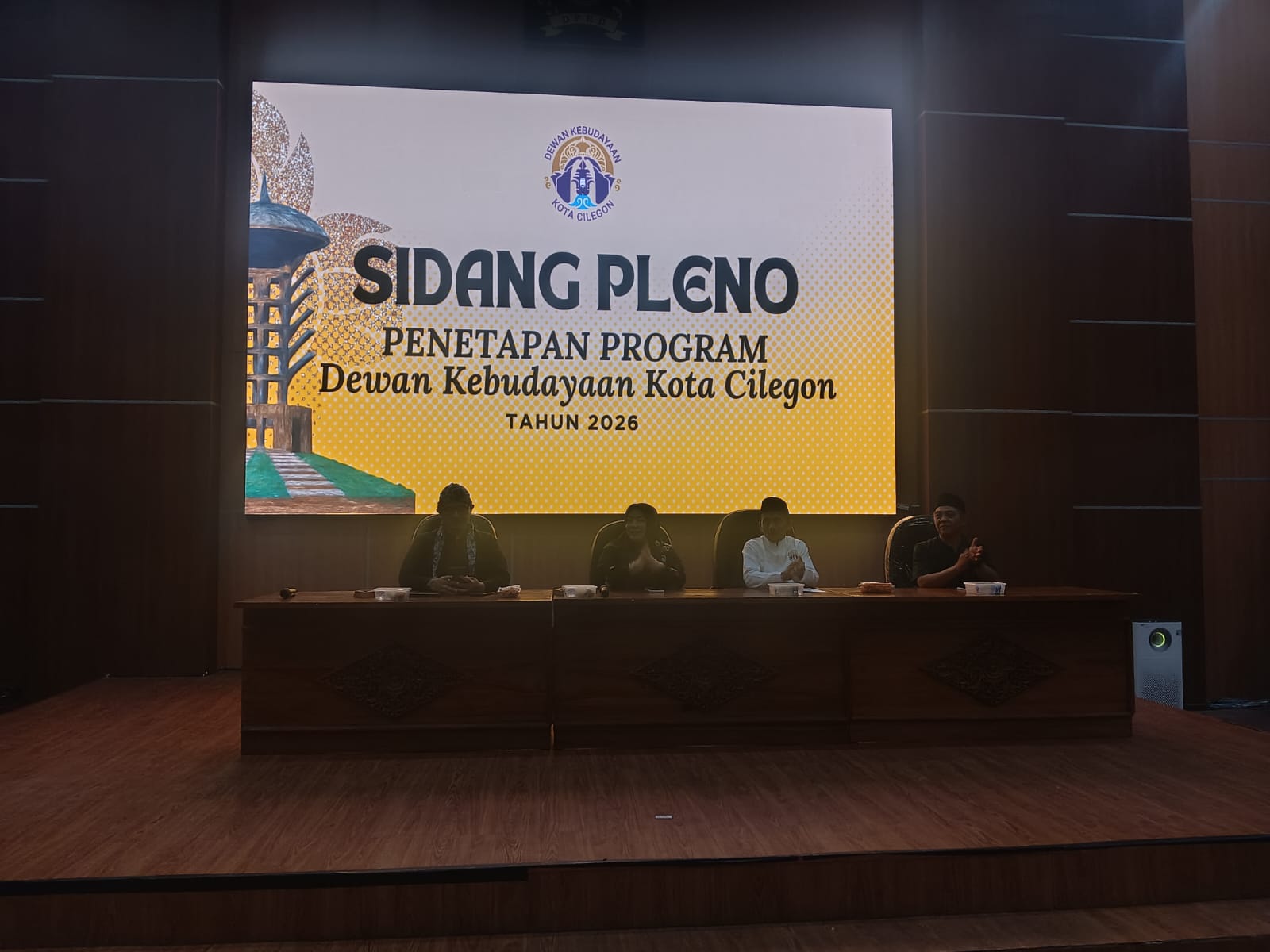
CCN, CILEGON — The Cilegon City Cultural Council (DKKC) has officially opened its Plenary Meeting to Finalise the 2026 Work Programme. The meeting marks an initial step in consolidating cultural development in Cilegon City, particularly in encouraging stronger regulation and budgetary support for arts and cultural practitioners.
Chairman of DKKC, Ayatullah Khumaeni, stated that cultural development in Cilegon must be implemented in a structured and sustainable manner, rather than being limited to ceremonial activities. The formulated work programme is expected to protect, develop, utilise, and preserve the community’s collective memory.
“This plenary meeting serves as a moment of consolidation. DKKC must become a shared home for artists, cultural figures, and the younger generation of Cilegon,” Ayatullah said on Friday evening (23 January 2026) at the Cilegon City DPRD Hall.
One of the key topics discussed was the acceleration of the Initiative Regional Regulation (Perda) on Culture. The regulation is considered essential as a legal foundation for cultural governance in Cilegon City, while also opening opportunities for the allocation of cultural grant funding in 2026.
So far, the absence of grant funding has been a major obstacle in supporting the welfare and activities of local cultural practitioners. “Our hope is that once the Perda is enacted, by 2026 we will already be able to propose grant allocations for cultural figures,” he added.
Meanwhile, DKKC Vice Chairman I, Bahroni, emphasised the need for the Cilegon City Government to formalise the 2026 cultural work programme as an official policy regulation. According to him, culture must become an integral part of the region’s development direction.
“A cultural work programme is not enough if it is merely designed; it must be formally established as policy. This is a form of government responsibility to ensure that culture remains alive in Cilegon,” Bahroni said on Friday (23 January 2026).
He further noted that cultural regulation is necessary to ensure that all regional government agencies share the same reference framework and to encourage inter-agency synergy in implementing cultural programmes. Without clear policy direction, efforts to advance culture risk becoming unfocused.
Bahroni also stressed that culture is a shared responsibility, not solely the domain of artists and cultural practitioners. The government, communities, educational institutions, and even the industrial sector must all be actively involved.
“Culture is the collective responsibility of all elements of the city. Collaboration must be built so that culture can grow and deliver tangible impacts,” he said.
Through strengthened regulation and cross-sector collaboration, DKKC hopes that culture will become a vital component of Cilegon City’s development and further reinforce the region’s identity in the future. (***)