

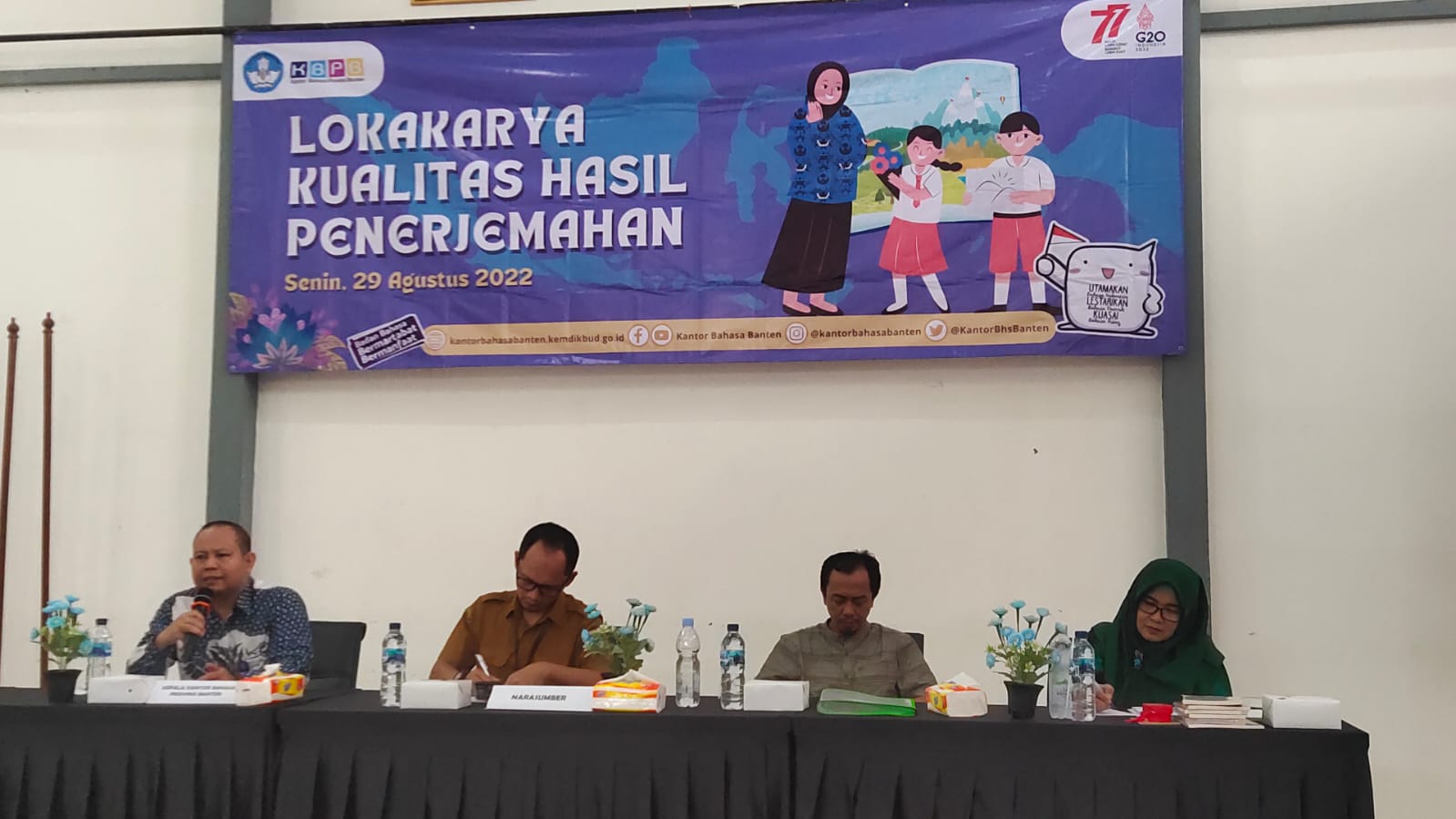
Serang, August 29th, 2022.The Banten Provincial Language Office, UPT Language Development and Development Agency, Ministry of Education, Culture, Research, and Technology, through the Translation Expertise and Professional Services Group, conducted a Workshop on the Quality of Translation Results.
Asep Juanda, S.Ag., M.Hum, Head of the Banten Provincial Language Office, said as many as seven folk stories were adapted into children’s stories in two languages. The seven Banten children’s story books in Indonesian, Sundanese, and Javanese dialects are intended to enrich children’s and adolescents’ reading materials, particularly by broadening their horizons about Banten culture.
When a person learns the language, they also learn the culture. When a person studies culture, he will study its language and literature. The more literary works that are translated into Indonesian or foreign languages, the more people will know about our culture, “said the Head of the Banten Provincial Language Office.
He also added that the workshop involving translation experts and practitioners such as Arip Sanjaya (Sultan Ageng Tirtayasa University Lecturer) and Tyas Tantaka (House of the World) was a form of commitment from the Banten Provincial Language Office to ensure the quality of translated children’s story books.
Evi Syaefudin, Plt Secretary for Library and Archives of Banten Province, Evi Syaefudin, S.Ag., M.Si., welcomed the efforts made by the Banten Provincial Language Office to add to the collection of children’s story books in two languages.
“In the collection list in the Library and Archives of Banten Province, there are 3582 titles of children’s story books, but almost none of them are in regional languages.” “What is being carried out by the Banten Provincial Language Office needs to be appreciated because it is a good step to be able to preserve the language and culture of the Banten people,” said Evi Syaefudin.
He also added that so far, writers in regional languages have been hampered by industrial demands that measure profit and loss, narrowing the space for writers to work.
On that occasion, as many as 27 participants, consisting of policy makers, local language activist communities, and translator practitioners, were present to provide input on the 7 translated stories.
“Banten’s pluralistic society has a wealth of folklore that has not been widely written or inventoried. On almost every occasion, I often find “that’s all” folklore. Hopefully, these 7 folktales that will be published will be a means of making an inventory of folklore and enriching reading for children and adolescents. “Hopefully, in the future, Banten will also have a special library for children and young people that stores a wealth of children’s stories and folklore from Banten,” added one of the speakers, Arip Senjaya.